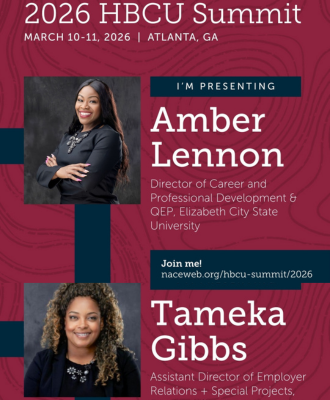
Elizabeth City, N.C. — Two leaders at Elizabeth City State University (ECSU) are proving that rural roots can make a big impact. Amber Lennon, Ed.D., director of career and professional development, and Tameka Gibbs, assistant director of employer relations and special projects, are featured in a National Association of Colleges and Employers (NACE) interview now live on the organization’s website as part of the lead-up to their presentation at the 2026 NACE HBCU Summit.
At the heart of the NACE feature titled, Relationship-Building, Hospitality Help ECSU Attract Employers to Its Rural Location, is a story of purposeful relationship-building, intentional hospitality and the belief that “rural doesn’t mean limited.” ECSU’s location in one of North Carolina’s Tier 1 counties might pose recruiting challenges. Still, the university is turning that perception into opportunity by bringing employers into close, personal contact with its students and community.
Gibbs explained how that hospitality sets ECSU apart.
“There are no luxury hotels here. But Elizabeth City is known as the ‘Harbor of Hospitality,’ and that’s what we provide for our employers who visit our campus.” She detailed how she greets recruiters, provides maps and parking passes and stays with them throughout their visits so they can make the most of their time at ECSU.
The interview also highlights the institution wide commitment to student success.
Lennon said, “As an NC Promise institution, ECSU makes sure that education is accessible, that our students have opportunities, and that we facilitate upward mobility.”
She elaborated on the career development team’s goal. “When it comes to career development, we want to make sure that we’re having transformative conversations with students. We will provide the resources, relationships and networking opportunities so that they get exactly what they need to find their success.”
Their session at the 2026 NACE HBCU Summit, Rural Doesn’t Mean Limited: Innovative Recruiting at a Small HBCU, will highlight best practices for attracting employers to a rural campus, including personalized engagement tactics, creative events such as employer takeover days, and networking at the campus Student Center.
The message is clear for ECSU and the students whose futures these efforts are shaping: intentional hospitality, deep relationships and a refusal to let location define opportunity are turning local commitment into national recognition.
Lennon and Gibbs prove that sometimes the biggest impact comes from the smallest towns. ECSU has rolled out the welcome mat and does not let its rural ZIP code limit a student’s reach.